

Courses
23-05-2023
Vote
-
For further training via the Zoom program or at our office? ?
Register a
Violation
We you
Contact youS.O.S.
0032 02 7322568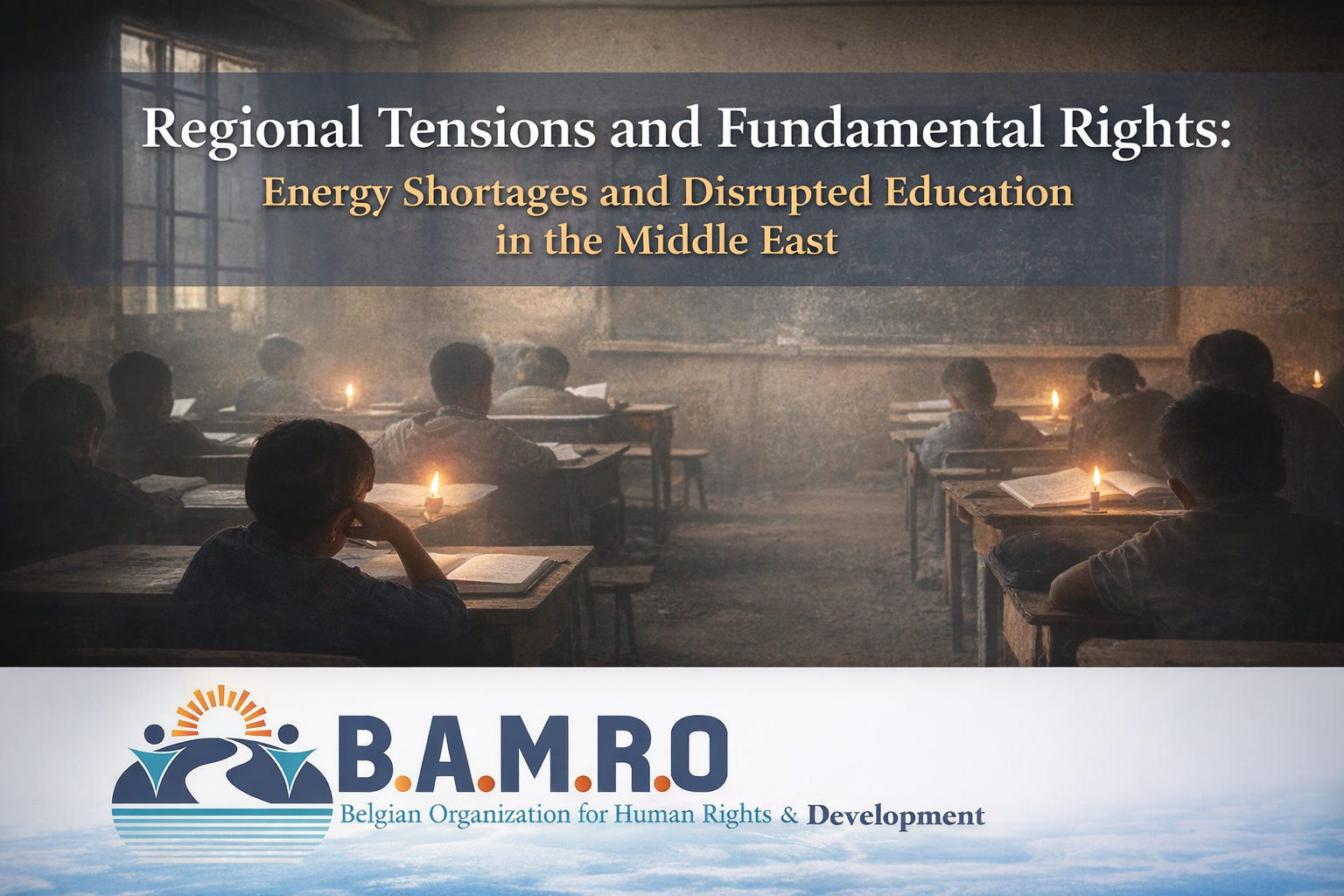
Regional Tensions and Their Impact on Fundamental Rights: Energy Shortages and Disruption of Education in the Middle East
The Middle East is currently witnessing rising regional tensions, particularly in the context of escalating confrontation between Iran and Israel. The consequences of these tensions are not limited to the direct parties involved in the conflict; their effects extend to other countries in the region that are already facing economic challenges and fragile infrastructure. Among the most visible consequences are growing energy shortages and electricity outages in countries such as Iraq and Lebanon, which directly affect civilians and their ability to enjoy fundamental human rights.
Many countries in the region rely on interconnected energy networks or fuel supplies that are influenced by regional political and security dynamics. As tensions escalate and supply routes are disrupted or affected by instability, some countries have begun to experience shortages of fuel needed to operate power plants. This has resulted in prolonged electricity cuts across various cities and regions.
Electricity outages are not merely a technical or service-related issue; they represent a serious human rights concern. Electricity is essential for ensuring access to healthcare services, clean water, communication systems, and education. Reports from several affected areas indicate partial disruption of educational institutions, where some schools have been forced to suspend or reduce classes due to the inability to operate facilities or because of security concerns linked to regional tensions.
The lack of electricity also directly affects students’ ability to continue their education. Many schools and universities increasingly rely on digital learning tools and electronic platforms. Without electricity, internet access, or adequate lighting at home, students face serious difficulties in maintaining their studies.
From a human rights perspective, the right to education is a fundamental right recognized by international legal frameworks, including the International Covenant on Economic, Social and Cultural Rights and the Convention on the Rights of the Child. Ensuring this right requires a stable and secure environment that allows students consistent access to education.
Prolonged disruptions in essential services may also lead to long-term social consequences, including increased school dropout rates, widening educational inequalities, and setbacks in human development within affected societies.
In this context, the Belgian Organization for Human Rights and Development (BAMRO) stresses that regional conflicts often produce indirect consequences that impact millions of civilians in neighboring countries, even when they are not direct parties to the conflict. Protecting fundamental rights—including the right to education and access to essential services—must remain a priority under all circumstances.
BAMRO also calls upon the international community to support countries affected by regional crises and to strengthen international cooperation to ensure the continuity of essential services, including energy supplies and educational infrastructure.
Regional tensions may appear political or military in nature, but their humanitarian consequences often affect the daily lives of ordinary people. This reality underscores the need for stronger international efforts to prevent the expansion of these crises and to safeguard the fundamental rights of civilians.
Listings
- 1
- 2
- 3
- 4
- 5